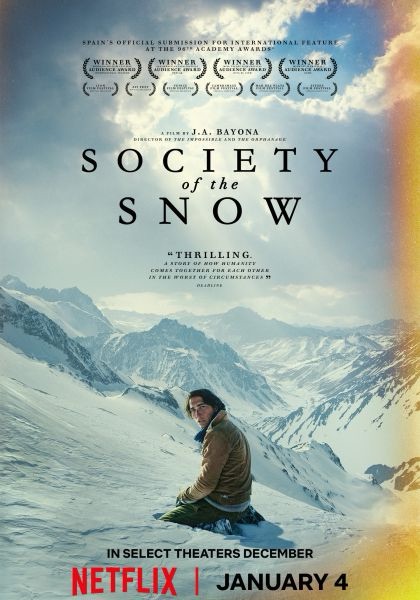
Honestly, I’m not particularly drawn to survival dramas, but I felt compelled to explore this one since it’s nominated for the Oscar Best International Feature Film, representing Spain. As I delved into reviews and filmmaker interviews, I found myself more intrigued by the process of making such a large-scale movie than the film itself.
“The Society of the Snow” (La Sociedad de la Nieve) depicts the real-life Uruguayan 1972 Andes flight disaster, also known as ‘The Miracles of Andes,’ where 16 passengers survived 72 days in harsh conditions after the plane crash. Following a group of high school rugby players en route to Chile for a match, the film highlights their close bond as a key strength amidst the adversity. I empathize with the filmmakers’ decision to emphasize this camaraderie, particularly in light of the harsh reality of cannibalism. While the film portrays the survivors resorting to eating the deceased to survive — the movie also explores themes of resilience and fellowship.
Numerous books, documentaries, and films have covered this disaster, including the 1993 movie ‘Alive!’ directed by Frank Marshall, based on British historian Piers Paul Read’s book with the same title. In contrast, ‘The Society of the Snow’ draws from Uruguayan journalist Pablo Vierci’s 2009 book, also titled the same. Director J. A. Bayona eloquently distinguishes the two works, noting how Vierci’s reflections, penned nearly forty years after the tragedy, delve deeper into psychological, spiritual, and human aspects.
Spanish director J. A. Bayona stumbled upon Vierci’s book while researching for his 2012 tsunami movie “The Impossible.” It significantly informed his understanding of human catastrophes. Bayona’s journey with “Society of the Snow” began over ten years ago when, on the last day of shooting “The Impossible,” he secured its rights.
Collaborating with screenwriters Nicolás Casariego and Jaime Marques, Bayona had extensive materials at hand, including 100 hours of recordings and ongoing communication with survivors and families. The filmmakers’ profound respect for both survivors and those who perished is palpable throughout the film, honoring their memory at every turn.
Shot over five months with a budget nearing 70 million dollars, the film primarily filmed at a ski station in Spain, making three trips to the Andes for establishing shots.
While I may not be a fervent fan of survival tales, delving into both ‘Alive!’ and ‘The Society of the Snow’ in tandem, by reading the books and then watching the movies, would undoubtedly offer an intriguing case study for real life adaptations.
 A Screenwriter’s Journey
Leave a comment