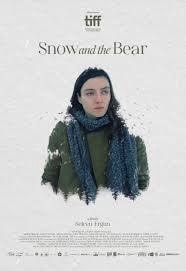
I’ve been eagerly anticipating this one for some time, and now it’s finally streaming on BluTV. By sheer chance, I happened to watch it on one of the coldest nights here, which perhaps helped me immerse myself into this deeply atmospheric, dark fairy tale.
Turkish filmmaker Selcen Ergün’s debut, “Snow and The Bear” (Kar ve Ayı), unfolds in a remote village cut off from the world by harsh winter. The tale begins with a young, idealistic nurse arriving in the village for her obligatory service. However, it takes a different turn when one of the villagers goes missing. As the investigation progresses, we are left unsure whom to trust in this rural society conditioned by patriarchy. Amidst rumors of bear attacks, the seemingly endless winter fosters a sense of entrapment.
The film, co-written with screenwriter Yeşim Aslan, premiered at the Toronto International Film Festival in 2022. It brought the San Francisco International Film Festival Golden Gate Award for New Director to Selcen Ergün and won awards for Best Feature Film, Best Screenplay, Best Editing, and Best Cinematography at the Bosphorus Film Festival.
Selcen Ergün’s journey as a Turkish woman filmmaker is quite inspirational for me, so I’ll go into more detail about the filmmaking process here more than usual. The film project was developed at the Berlinale Talents Script Station, Nipkow AIR, Cannes Film Festival La Maison Des Scénaristes, and First Films First. It was awarded as the best project in development in 2017 and later as the best work-in-progress film in 2021 at the Meetings on the Bridge Platform of Istanbul International Film Festival as well as at the Bosphorus Film Lab. The film is a Turkish, German, Serbian co-production.
In one of the interviews, Ergün describes this international production process: “Step by step, we were supported by the Republic of Türkiye Ministry of Culture and Tourism, the German-Turkish Co-Production Development Fund, TRT, Filmförderung Hamburg Schleswig-Holstein, Film Center Serbia, and finally, by Eurimages. So this film and its intimate story set in a small isolated community owe their existence to collaboration on an international scale. It was edited in Hamburg, color-graded in France and Turkey, music scored remotely in the United States, and the sound design was made in Istanbul.”
Regarding the inspiration for the story, Ergün points out two things: “The sense of always being on alert as a woman and the asymmetric relationship we build with nature.” As a woman, I know all too well the feeling of walking on eggshells. But I also know that when the world makes you fear that much, you have no choice but to grow courage inside. And I can see traces of it in the character of Aslı. While not the most rebellious character, she refuses to engage in power dynamics in the village and resists her father’s attempts to pull strings for her.
It wasn’t highlighted in any of the reviews I’ve read, but I think it’s worth mentioning that the dialogues are on point both in rhythm and content-wise. They sound very natural. In one of the interviews, Ergün states, “In my childhood, I lived in a city with my family, but I visited my grandmother who lived in a village during the holidays. I listened curiously to the women chatting there.” I think her experiences and observations during her childhood translated well to the film.
P.S: If you’ve already watched “About Dry Grasses” by Nuri Bilge Ceylan and are surprised to see Merve Dizdar here as a character having her obligatory service in a snowy town once again, I must say this film came first, for the record! 😊
 A Screenwriter’s Journey
Leave a comment