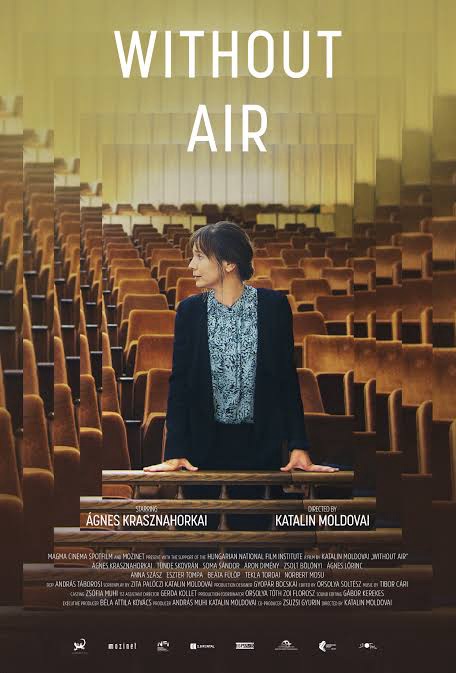
What if an idealistic high school teacher’s recommendation of a film to her students resulted in a complaint to the school management? And what happens if that seemingly trivial incident gets out of control and turns into a witch hunt? Hungarian director Katalin Moldavai explores these questions in her feature debut, “Without Air,” offering timely messages about freedom of expression amidst themes of political oppression, cultural conservatism, and the erosion of the education system.
The 2023 Hungarian movie “Without Air,” co-written with Zita Palóczi, premiered at the Toronto International Film Festival and garnered awards like the Fibresci Award for Best Film, the Young Fibresci Jury Award for Best Eastern European Debut Film, and the Best Film Award at the Warsaw International Film Festival.
The story is set in a tiny Hungarian village but is inspired by a real-life event from Romania in 2017. Like the movie’s plot, a literature teacher assigned the viewing of Agnieszka Holland’s “Total Eclipse,” a film depicting the complex relationship between 19th-century French poets Arthur Rimbaud and Paul Verlaine. After a conservative parent accused her of promoting homosexual propaganda, her life turned upside down. Director Moldavai found inspiration after reading a newspaper article about Adela Stan’s story. She even reached out to the teacher to gain more details and insight into the process.
What I like most about this film is how timely and universal its themes are. Freedom of expression is in danger in the face of rising cultural conservatism around the world. Yet, of course, in some places, the situation is heavier, and the atmosphere is more suffocating than in other countries, such as in my country, Turkey.
The film gracefully blends the poetic and political aspects. I truly admire that, especially because I’m also working on a similar story. I hope to achieve a similar balance, avoiding heavy-handedness. I believe handling such social narratives requires careful consideration to avoid becoming a propagandist filmmaker who overwhelms the audience with messages.
While I appreciate how the story escalates with the involvement of media and other teachers at the school, I believe there are missed opportunities to make it more compelling. I understand telling it in a straightforward manner is an artistic choice, but I can’t help but think I would take a different route as a writer. I would hierarchize the information we receive as an audience to increase curiosity and anticipation. For example, we wouldn’t need to know whose parent made the accusation initially. This way, the audience would be alongside Ana as she tries to figure out who the whistleblower is. I would make her more suspicious in this process too. Everyone would feel like an enemy at that point, fostering a maddening paranoia, much like in Third Reich Germany. Eventually, we would learn that the fuss is stirred by her favorite student’s father, creating anticipation: what would Ana do when she discovers this? We’d witness Ana drawing closer to the student, keeping us on the edge of our seats. She’d be playing with fire unknowingly.
Overall, despite some areas that could be further developed, I still find the film praiseworthy. Now, I should really return to my own writing instead of attempting to rewrite someone else’s story that has already been made into a film. 😊
 A Screenwriter’s Journey
Leave a comment