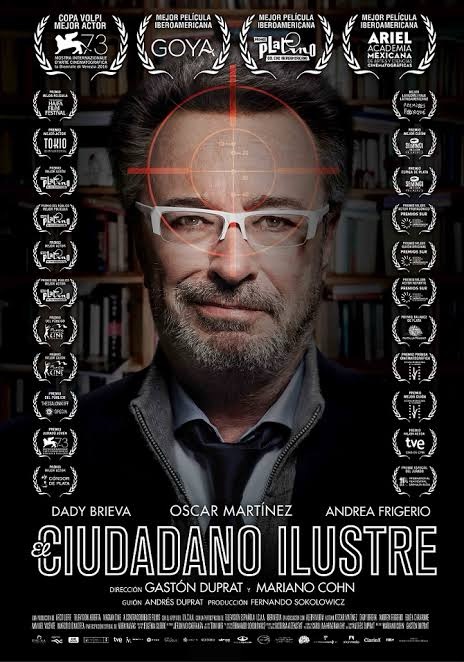
Once again, here we are in the realm of those wonderfully eccentric Argentinian filmmakers: Mariano Cohn and Gastón Duprat. They’ve captivated me before with their dark humor and expert characterizations in TV shows like “El Encargado” (The Boss) and “Nada” (Nothing). I simply fell in love with their work then, and now, after delving into their 2016 film, “El Cuidadano Ilustre” (The Distinguished Citizen), I’m happy to report that my admiration for them remains steadfast, if not grown stronger.
In “The Distinguished Citizen,” we’re taken on a journey following a Nobel Prize-winning Argentinian author returning to his small hometown after 40 years. As the sophisticated and enigmatic writer inevitably clashes with the narrow-minded locals, we’re given the opportunity to reflect on themes such as identity, origins, art, and fame. Ultimately, the film reinforces the age-old adage that “no one can be a prophet in their own land.”
While Cohn and Duprat shared the directorial helm, the screenplay was crafted by Duprat’s brother, Andrés Duprat, who is also an architect and museum director. He drew inspiration from his experiences as an art curator evaluating works in small towns for this story.
I found it amusing to watch the irony of a writer drawing inspiration from his hometown for his novels yet struggling to tolerate its inhabitants in real life. It speaks to the disparity between imagination and reality.
What I truly appreciate about these filmmakers is their refusal to romanticize either the writer or the small-town folk. They skillfully portray characters who are imperfect yet sympathetic, all while infusing their trademark dark humor. We see that the writer is egoistic and stubborn, while the small-town people are jealous and peacocky.
The film competed for the Golden Lion at the Venice International Film Festival and received numerous awards, including Goya Awards for Best Ibero-American Film and Platino Awards for Best Screenplay. However, it wasn’t without its critics. One review I’ve read criticized its cinematography, likening it to “the TV equivalent of a funny airport novel.” While I found this comment a bit cruel, personally, I would have also enjoyed a more stylistic approach like their TV show “Nada” (Nothing).
Lastly, I found it intriguing that alongside the film’s release, they published a book “written” by the main character of the film. Although not a retelling of the film’s story, the book offers a tale inspired by the writer’s hometown visit, as if it were written after the events of the film. The filmmakers claim it was penned by a ghostwriter of considerable literary stature. I think it’s a fun move that blurs the lines between fiction and reality even further.
 A Screenwriter’s Journey
Leave a comment